
DIRFloortime Activities Parents Can Practice at Home Daily: Building Engagement Skills
May 22, 2026
Practical DIRFloortime activities parents can use daily to build engagement, communication, and connection at home.
-ink.jpeg)
Key points:
- Learn how to use everyday routines as powerful moments for connection, communication, and shared attention.
- Discover practical Floortime activities for home practice that build engagement step by step.
- Gain confidence with clear, realistic ways of implementing Floortime at home daily without overwhelm.
Children grow through relationships. When a child struggles with engagement, communication, or regulation, daily interactions at home become especially important. DIRFloortime is a developmental, relationship based approach designed to strengthen connection first, then build skills through shared play and emotional engagement.
Research from university based developmental programs and national child health organizations consistently highlights that responsive, back and forth interactions between caregivers and children support language, emotional regulation, and social development. The early years are especially sensitive to this type of learning.
This article offers practical, family centered guidance on Floortime activities for home practice that you can use every day. You will find simple strategies, concrete play ideas, and realistic ways to build engagement in short, meaningful moments, without turning your home into a therapy clinic.
Understanding Engagement in DIRFloortime
Engagement is the foundation of all learning. In DIRFloortime, engagement means your child is emotionally connected, interested, and participating in a shared experience with you.
Developmental research shows that children learn best when they feel safe and emotionally connected. Joint attention, shared problem solving, and turn taking are core building blocks for communication and thinking. When you focus on connection first, skills often follow more naturally.
DIRFloortime emphasizes six core developmental capacities, including:
- Self regulation and shared attention
- Engagement and relating
- Two way purposeful communication
- Complex communication and problem solving
- Emotional ideas
- Emotional thinking
Your role at home is not to master clinical techniques. Instead, it is to create frequent, warm, responsive interactions. That is where parent-led Floortime activities become powerful.
Preparing for Daily Floortime at Home
Before jumping into play, set up the conditions for success.
Choose the right moment. Your child is more likely to engage when they are:
- Well rested
- Not hungry
- Not overstimulated
Keep sessions short. Ten to twenty minutes of focused interaction is often more effective than an hour of distracted play. Many families find that daily Floortime activities at home work best when spread across the day in small bursts.
Follow your child's lead. Observe what captures their interest. Are they lining up cars, spinning objects, pretending to cook, jumping on the couch? These interests are entry points, not obstacles.
When implementing Floortime at home daily, remember three principles:
- Get down on the floor at your child's level
- Join their activity without taking over
- Add small playful challenges to encourage interaction
This is the heart of simple Floortime techniques for parents.
Simple Floortime Techniques for Parents
You do not need special materials to practice DIRFloortime. What matters most is how you interact.
Here are core home based Floortime strategies you can use right away.
1. Follow, Then Expand
Start by imitating what your child is doing. If they are pushing a car, push one too. If they are stacking blocks, stack alongside them.
Once engagement is established, gently expand:
- Add a sound effect
- Create a small obstacle
- Pause and wait for their response
This approach forms the basis of many DIRFloortime exercises parents can do without preparation.
2. Open and Close Communication Circles
A communication circle begins when one person initiates and ends when the other responds. Your goal is to keep circles going.
For example:
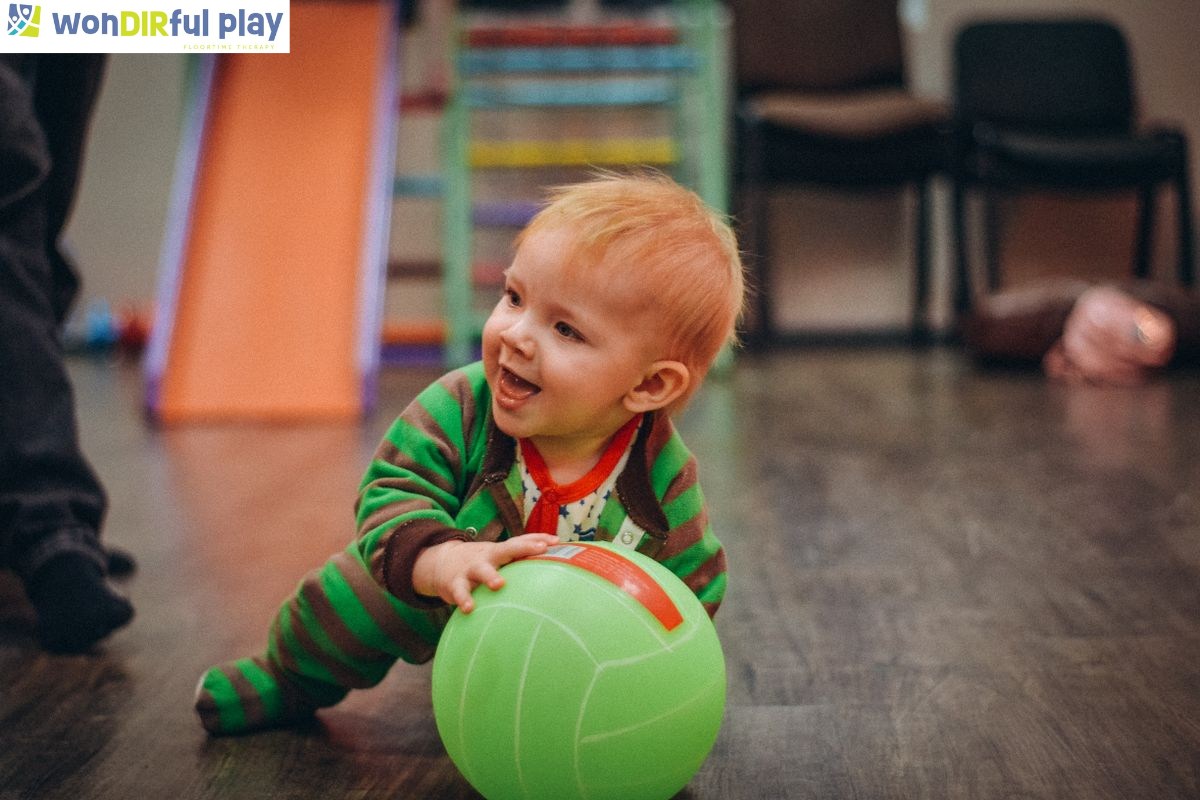
- You roll a ball
- Your child rolls it back
- You say, your turn
- They push it again
Each back and forth builds attention and shared meaning. Over time, this supports language and problem solving.
3. Use Playful Obstruction
-ink.jpeg)
Playfully block access to a desired object, not to frustrate, but to invite interaction. Hold the toy lightly and wait for eye contact, a gesture, or a sound.
This technique encourages purposeful communication and is one of the most effective easy Floortime games for home.
Floortime Play Ideas for Toddlers
Toddlers thrive on movement, repetition, and sensory experiences. The key is to turn these into interactive moments.
Here are practical Floortime play ideas for toddlers:
- Chase and pause games, run toward your child, then freeze and wait for a cue to continue
- Bubbles with anticipation, blow a few, then pause and wait for eye contact or a gesture
- Rolling games, sit facing each other and roll a ball back and forth
- Silly songs with actions, stop mid song and wait for your child to signal for more
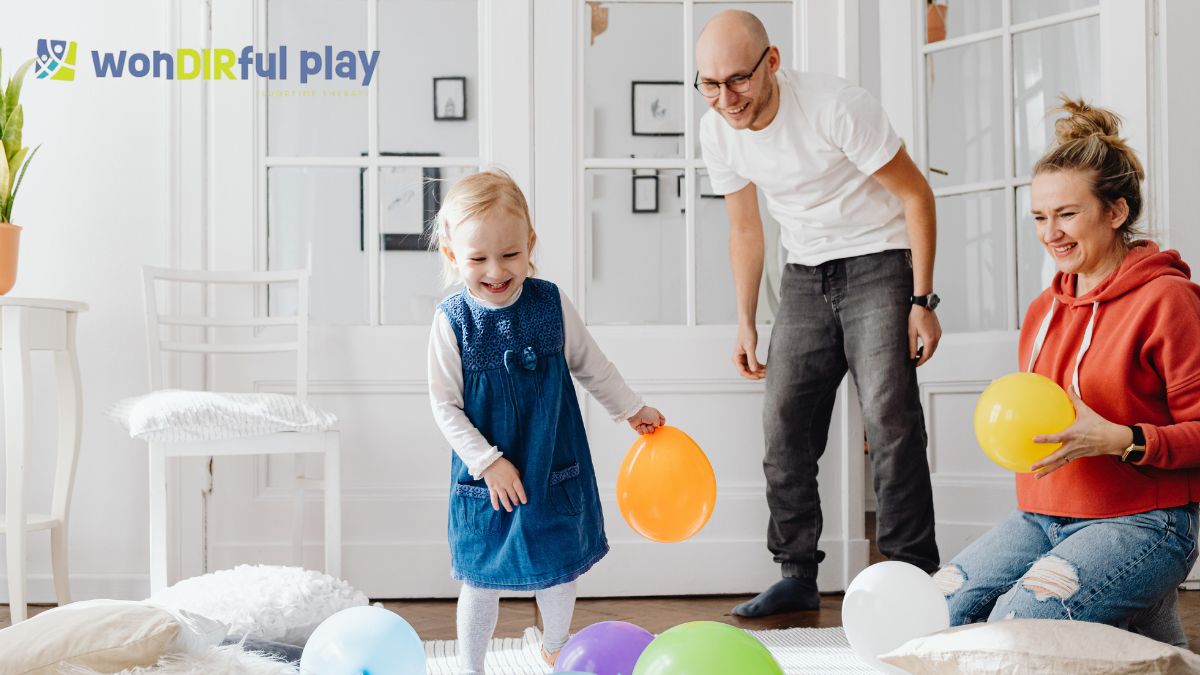
These activities strengthen shared attention and joyful connection. They also make implementing Floortime at home daily feel natural rather than forced.
Floortime Exercises for Preschoolers
Preschoolers often enjoy imaginative play and simple problem solving. This stage is ideal for building more complex communication.
Effective Floortime exercises for preschoolers include:
- Pretend play scenarios, such as cooking, going to the doctor, or building a zoo
- Creating small challenges, for example a broken bridge that needs fixing
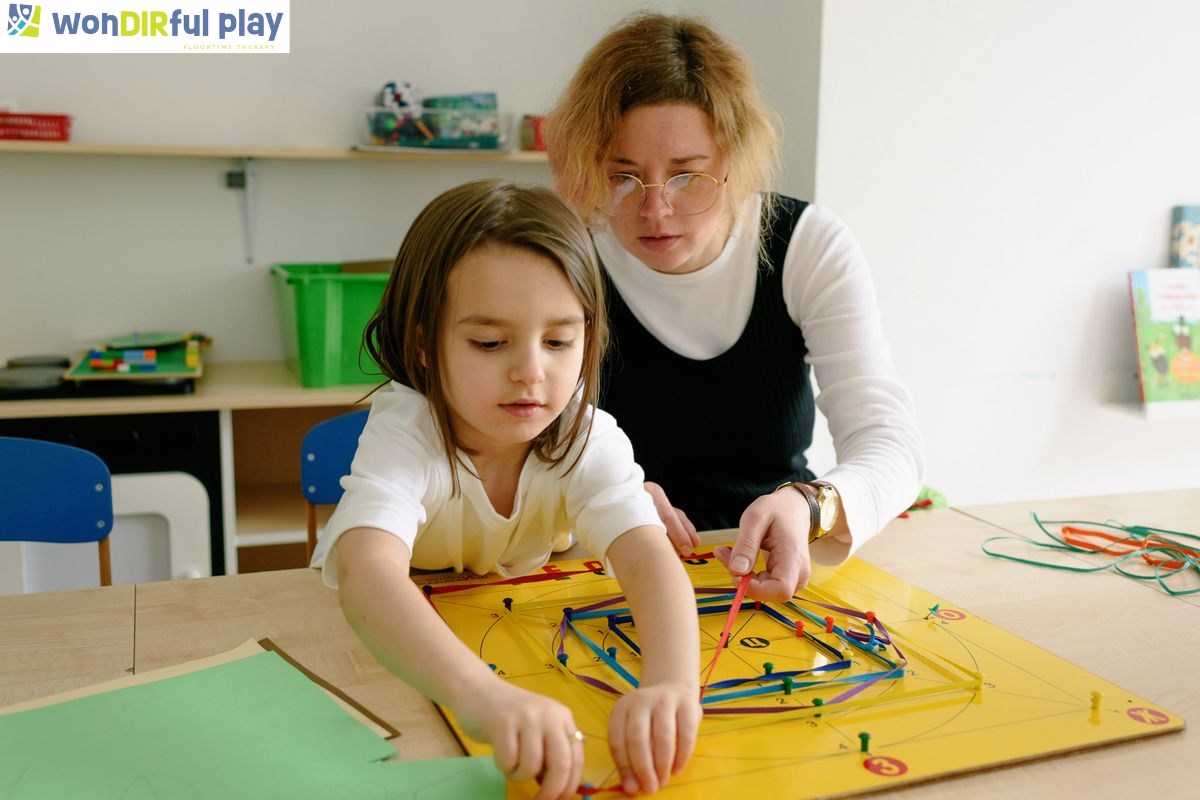
- Turn taking board games with simple rules
- Collaborative building projects with blocks or magnets
During these activities, encourage your child to:
- Share ideas
- Express emotions through characters
- Solve small problems with you
These interactions expand emotional thinking and flexible problem solving, core goals of DIRFloortime.
Practicing Floortime Between Sessions
If your child receives professional support, home practice strengthens progress. Many providers assign DIRFloortime homework for parents, but the most meaningful work often happens in daily life.
Practicing Floortime between sessions can look like:
- Turning bath time into a shared splash and pour game
- Making snack time interactive by offering choices and waiting for responses
- Using bedtime stories to pause and ask, what happens next
Consistency matters more than perfection. When you integrate parent-led Floortime activities into routines, you multiply opportunities for growth.
Turning Daily Routines into Engagement Opportunities
Some of the most powerful home based Floortime strategies happen during ordinary moments.
Mealtime
- Offer two choices and wait for a response
- Make silly faces and invite imitation
- Pause before giving a favorite food to encourage communication
Dressing
- Put a shirt on your own head and act confused
- Wait for your child to correct you
- Celebrate their effort to communicate
Outdoor Time
- Play stop and go games
- Build simple obstacle courses
- Create shared challenges like carrying sticks together
These moments transform daily tasks into meaningful Floortime activities for home practice.
Managing Challenges During Floortime
-ink.jpeg)
Some days will feel harder. Your child may avoid eye contact, become frustrated, or lose interest quickly. This is normal.
When engagement drops:
- Lower your demands
- Match their energy level
- Reconnect through something they already enjoy
If your child becomes dysregulated:
- Slow your voice
- Reduce sensory input
- Offer deep pressure hugs if they find them calming
Flexibility is essential when implementing Floortime at home daily. Progress often comes in small, steady steps.
Creating a Sustainable Home Floortime Routine
To make daily Floortime activities at home sustainable:
- Schedule one predictable time each day
- Keep materials accessible and simple
- Reflect briefly on what worked
Avoid comparing your child to others. Focus on increased engagement, longer back and forth exchanges, and more shared joy.
Over time, these consistent interactions strengthen neural pathways related to communication, emotional regulation, and social understanding. Research in early childhood development repeatedly shows that responsive caregiving shapes long term outcomes.
You do not need to do everything at once. Choose two or three DIRFloortime exercises parents can do comfortably, then build from there.
FAQs
How long should a daily Floortime session be?
Ten to twenty minutes of focused interaction is effective. Short, frequent sessions are better than long, inconsistent ones.
What if my child ignores me during play?
Start by observing and joining their activity without changing it. Once engagement builds, add small playful challenges.
Can siblings join Floortime activities?
Yes. Siblings can model interaction and turn taking, as long as the focus remains on connection and shared engagement.
Do I need special toys for Floortime at home?
No. Everyday objects, balls, blocks, kitchen items, and books are enough for meaningful interaction.
How do I know if progress is happening?
Look for longer engagement, more eye contact, increased gestures or words, and greater flexibility during shared play.
Turn Everyday Moments Into Developmental Wins
When parents practice Floortime between sessions, progress often accelerates. Small, consistent interactions during snack time, bath routines, or pretend play can become powerful developmental opportunities.
WonDIRfulPlay coaches families across New Jersey on implementing Floortime at home daily with confidence. We provide DIR Floortime homework for parents, share play ideas for toddlers and preschoolers, and demonstrate simple techniques that feel natural rather than scripted.
If you are ready to build engagement skills beyond the therapy room, contact our team. We will help you design a home plan that blends seamlessly into your family’s rhythm.
Recent articles


.jpg)
.jpg)




.jpg)


.jpg)






.jpg)



-ink.jpeg)
-ink.jpeg)
-ink.jpeg)
-ink.jpeg)
-ink.jpeg)
-ink.jpeg)
-ink.jpeg)
-ink.jpeg)
-ink.jpeg)


.jpeg)

.jpg)
-ink.jpeg)

.jpg)

-ink.jpeg)

-ink.jpeg)
-ink.jpeg)
.jpg)
.jpg)
-ink.jpeg)
-ink.jpeg)
.jpg)

-ink.jpeg)
-ink.jpeg)
-ink.jpeg)
-ink.jpeg)
-ink.jpeg)
-ink.jpg)
-ink.jpeg)
-ink.jpeg)
-ink.jpeg)
-ink.jpeg)
.jpg)
.jpg)
-ink.jpeg)
-ink.jpeg)
.jpg)
-ink.jpeg)
-ink.jpeg)
-ink.jpeg)
-ink.jpeg)
-ink.jpeg)
-ink.jpeg)
-ink.jpeg)
-ink.jpeg)
-ink.jpeg)
-ink.jpeg)
-ink.jpeg)
-ink.jpeg)
-ink.jpeg)
-ink.jpeg)
-ink.jpeg)


With WonDIRfulPlay, growth feels effortless and joyful. Our DIR floortime therapy services in Lakewood, NJ focus on building emotional connections, communication, and social confidence while addressing sensory and behavioral challenges.
For compliance matters, please call 732-523-9070 or email compllance@wondirfulplay.com

