
Understanding Gestalt Language Processing in Autism and How DIR Floortime Supports Echolalia
August 3, 2026
Learn how gestalt language processing in autism connects to echolalia, and how DIR Floortime helps children build flexible speech.
-ink.jpeg)
Key points:
- Gestalt language processing in autism means kids learn whole phrases first, and that is a valid path toward talking.
- Echolalia is not random repetition. It is a real sign of natural language acquisition in autism at work.
- DIR Floortime for echolalia builds connection first, so children can move toward flexible, spontaneous speech at their own pace.
If your child repeats lines from their favorite show, or says the same phrase every time they want a snack, you are watching gestalt language processing in autism happen in real time. This is not a delay or a bad habit. It is one real way that language grows.
A lot of parents get told to stop the repeating, and that advice usually misses what is actually going on inside a child's mind.
In this guide, you will learn what gestalt language processing looks like day to day, why echolalia shows up so often in autistic kids, and how DIR Floortime works with a child's own pace instead of against it. You will also see how scripting connects to real speech growth and what you can try at home this week.
What Is Gestalt Language Processing in Autism?
Most speech and language guides talk about kids learning single words first. Ball. Dog. More. Then those words get combined into short phrases.
Gestalt language acquisition in autism works differently. Children pick up whole chunks of language first, like full sentences or lines from a show, before they break them into smaller pieces. A child might say "let's go for a ride" as one solid unit, long before they understand that those are three separate words they can mix and match.
This pattern shows up a lot in autistic children, though it is not limited to autism. Research on speech and language development shows that gestalt processors move through their own set of stages on the way to flexible language. The chunks come first. The breaking apart comes later. Rushing that order does not speed things up; it just adds pressure.
Once you see this pattern, a lot of your child's speech starts to make more sense. Those repeated lines are not filler. They are building blocks.
Understanding Echolalia in Autism
Echolalia means repeating words or phrases someone else has said. It gets a bad reputation, but it plays a real role in how kids build joint attention and communication skills over time.
There are two main types worth knowing about.
Immediate Echolalia
-ink.jpeg)
This happens right after your child hears something. You ask "Do you want juice?" and they answer "Want juice?" instead of yes or no. It looks like a non-answer, but it is often your child processing the question by replaying it first.
Delayed Echolalia
This shows up later, sometimes hours or days after your child first heard the phrase. A line from breakfast might pop back up at bedtime, attached to a totally different situation. This is often your child pulling a stored script to fit a new moment, which is actually a form of problem-solving.
Both types are part of how many autistic kids build nonverbal communication strategies and eventually spoken ones. Neither one needs to be corrected out of existence.
How DIR Floortime Supports Natural Language Acquisition
DIR Floortime for echolalia takes a different starting point than programs built around correcting speech. It starts with connection.
Here is what that looks like in practice.
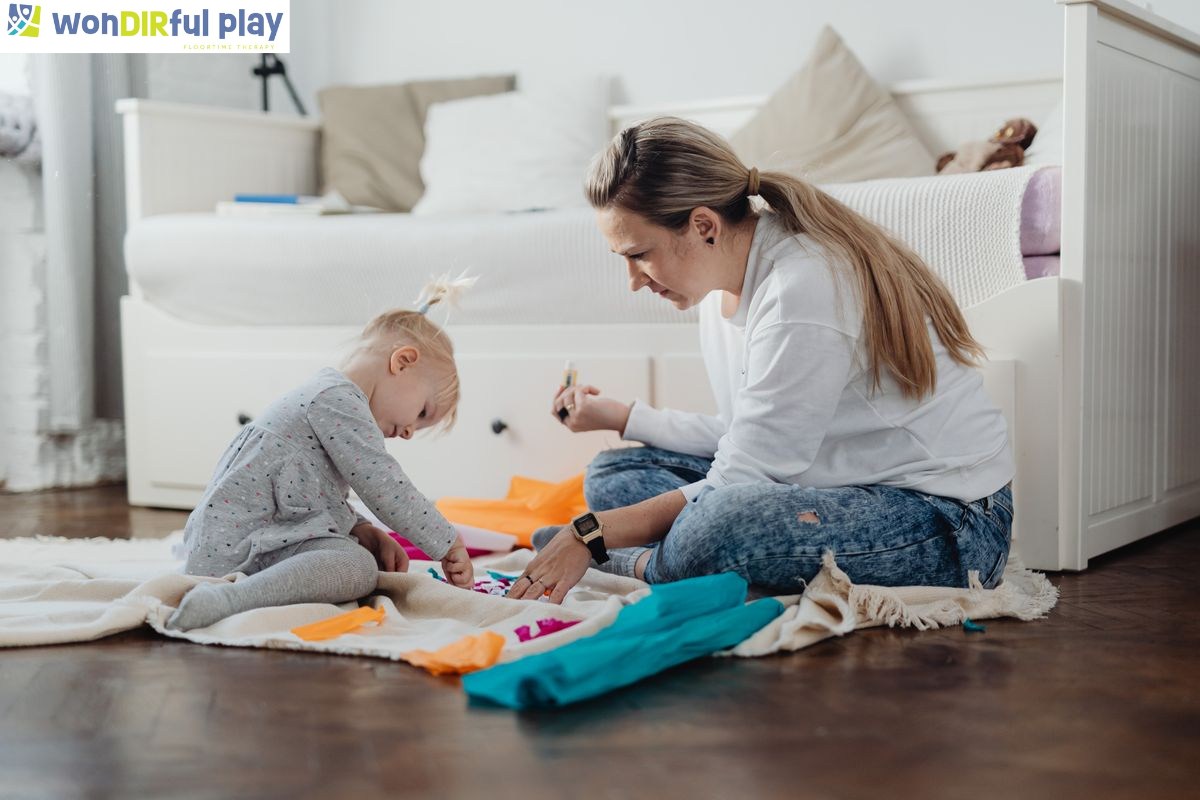
- A therapist or parent follows the child's lead during play, joining whatever the child is already doing.
- Instead of asking a child to "use their words," the adult responds to the meaning behind a script, even when the words are borrowed from somewhere else.
- Sessions build circles of communication, where the adult and child go back and forth, layering small variations onto the child's favorite phrases.
- Over time, this back-and-forth stretches a child's flexibility with language, without forcing them out of the words that feel safe.
Families often start this work through in-home Floortime sessions, where a therapist can build these moments right into daily play in a familiar setting. Some families also lean on family training and support, so these strategies carry over into everyday routines, not just therapy time.
Autism therapy for echolalia works best when it treats repeated speech as a starting point, not a problem to erase.
Moving Through the Stages of Gestalt Language Acquisition
Gestalt language processors tend to move through recognizable stages, though timing looks different for every child.
Early on, a child leans on whole scripts, often tied closely to the source. Over time, those scripts get mixed and matched, a phrase from one show combined with a phrase from another. Eventually, kids start pulling single words out of their scripts and using them on their own, which opens the door to original, self-generated sentences.
This progression takes patience. Some late talkers spend a long stretch in the early stages before things click, and that is normal, not a sign something is wrong.
DIR Floortime for language delay supports this whole arc, since it does not require a child to skip ahead. A toddler working through early gestalt stages gets the same respect and responsiveness as an older child breaking scripts into original phrases.
Scripting and Speech Development: What Parents Should Know
Scripting gets mixed up with echolalia, but it is worth separating the two. Scripting usually means a child leans on a memorized line from media, a book, or a past conversation, and uses it in a new context on purpose.
A few things to keep in mind about scripting in autism and speech development.
- Scripts often carry real meaning, even when the words came from somewhere else first.
- Blocking scripts outright can shut down communication rather than build flexible speech.
- Responding to the intent behind a script, then modeling a slightly varied version, helps stretch language naturally.
- Visual supports, including tools like the Picture Exchange Communication System, can work alongside scripting rather than replace it.
Some families pair Floortime with speech therapy so scripting gets supported from more than one angle. The two approaches tend to complement each other well.
Building Language Skills at Home
-ink.jpeg)
You do not need a therapy session to support this work. A few small habits go a long way.
- Repeat your child's scripts back with a small twist, then pause to see what they do with it.
- Fold favorite phrases into daily routines, like snack time or getting dressed, so language connects to real moments.
- Follow your child's play instead of redirecting it, and respond to the feeling behind their words.
- Ask your therapy team about parent training if you want more hands-on coaching for this at home.
Small, consistent moments add up faster than long, structured drills. Every family's service plan should reflect how your specific child communicates, not a one-size-fits-all script.
Frequently Asked Questions
Is echolalia a sign my child will never speak in their own words?
No. Echolalia is often an early stage of language building. Many gestalt language processors move toward original, flexible speech over time with the right support.
Should I stop my child from repeating lines from shows?
Not usually. Blocking scripts can shut down communication. Responding to the meaning behind the words tends to work better than correcting them.
How is Gestalt language processing different from typical language delay?
Gestalt processors learn whole chunks first, then break them into pieces. It is a different order, not necessarily a slower one.
Can DIR Floortime work alongside speech therapy?
Yes. Many families combine the two, since Floortime builds connection and speech therapy targets specific language goals.
At what age does gestalt language acquisition usually happen?
It can show up at any age once a child starts using language, though it is often noticed in toddlers and preschoolers first.
Turning Repeated Words Into Real Conversations
Every phrase your child repeats is a piece of the puzzle, not noise to filter out. Gestalt language processing in autism rewards patience over correction, and DIR Floortime gives that patience a real structure to grow inside of.
WondirfulPlay helps families read the meaning behind scripts and echolalia, then builds on it session by session until flexible language starts to show up on its own.
Reach out to WondirfulPlay to talk through where your child is in their language journey, and what natural next steps for DIR Floortime for echolalia could look like for your family.
Recent articles


-ink.jpeg)
-ink.jpeg)
-ink.jpeg)
-ink.jpeg)
-ink.jpeg)
-ink.jpeg)
-ink.jpeg)
-ink.jpeg)


.jpeg)
.jpg)



.jpg)
-ink.jpeg)

.jpg)

-ink.jpeg)

-ink.jpeg)
-ink.jpeg)
.jpg)
.jpg)
-ink.jpeg)
-ink.jpeg)
-ink.jpeg)
.jpg)

-ink.jpeg)
-ink.jpeg)
-ink.jpeg)
-ink.jpeg)
-ink.jpeg)
-ink.jpg)
-ink.jpeg)
-ink.jpeg)
-ink.jpeg)
-ink.jpeg)
.jpg)
.jpg)
-ink.jpeg)
-ink.jpeg)
.jpg)
-ink.jpeg)
-ink.jpeg)
-ink.jpeg)
-ink.jpeg)
-ink.jpeg)
-ink.jpeg)
-ink.jpeg)
-ink.jpeg)
-ink.jpeg)
-ink.jpeg)
-ink.jpeg)
-ink.jpeg)
-ink.jpeg)
-ink.jpeg)

-ink.jpeg)
-ink.jpg)
-ink.jpeg)
-ink.jpeg)
-ink.jpeg)
-ink.jpeg)














With WonDIRfulPlay, growth feels effortless and joyful. Our DIR floortime therapy services in Lakewood, NJ focus on building emotional connections, communication, and social confidence while addressing sensory and behavioral challenges.
For compliance matters, please call 732-523-9070 or email compllance@wondirfulplay.com

